
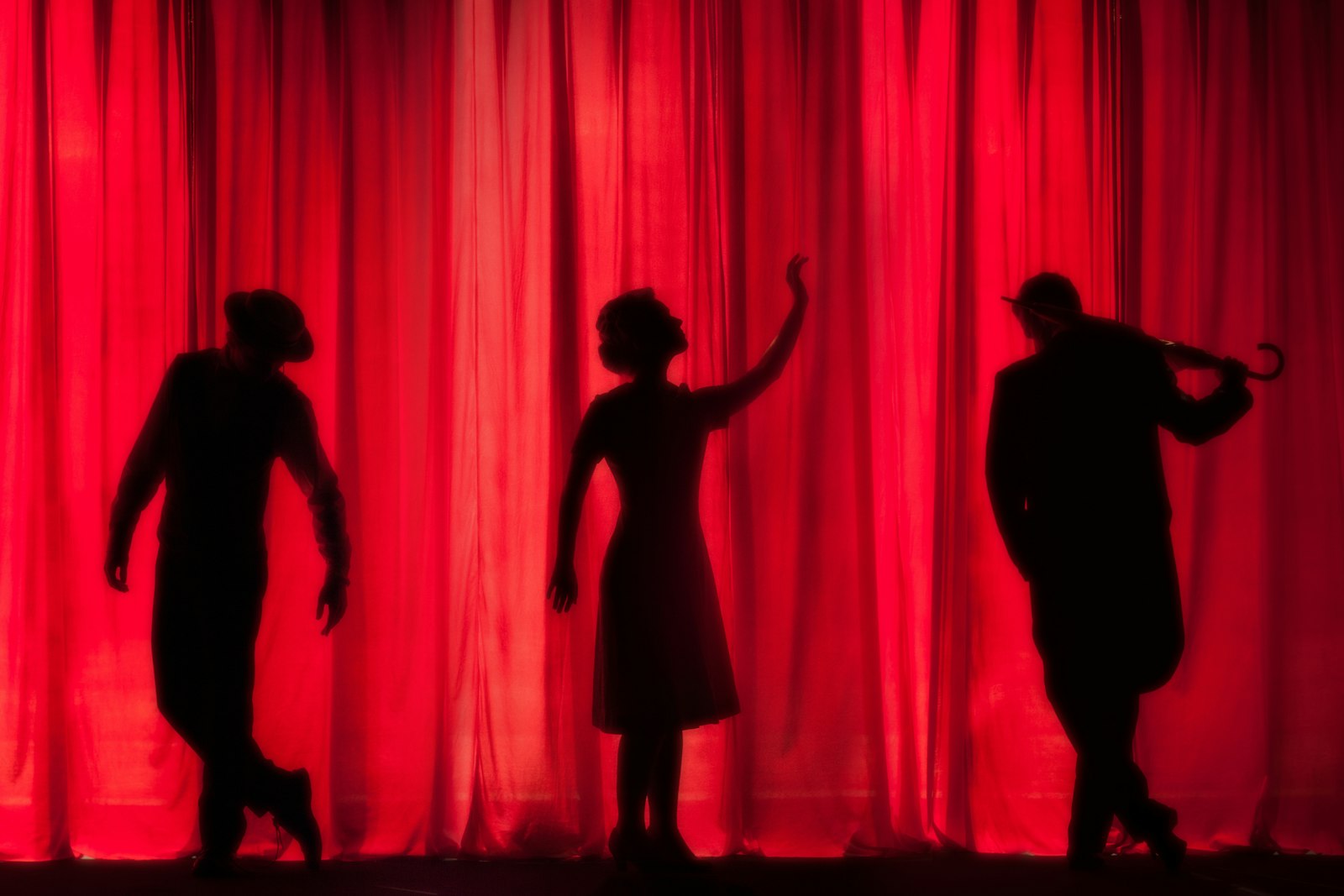
In your head, the audience is looking at her hands. She is not speaking, and the silence is unbearable. Then a director reads the page and asks the question that rearranges everything: where is everyone else standing while this happens?
There is no close-up in a theatre. Nobody can cut. Two hundred people share one wide shot for two hours, and whatever the audience notices, they notice because you gave them a reason to look. Writing a play is writing for a room, in real time, with no camera to point.
The unit of a play is the entrance
Screenwriters think in scenes, because a cut is free. On stage a change of place is expensive — a blackout, a set move, thirty seconds of an audience watching furniture. So the playwright's basic move is not changing the place. It is changing who is in the room.
Each entrance and exit resets the balance of power, the permissible subjects, and the level of honesty. Two people can say things a third makes impossible. That is why a stage play can hold an audience for ninety minutes in one kitchen, and why a play that changes location eleven times usually feels thinner than one that never moves.
A structural exercise before you write anything:
List every entrance and exit in your play in order, with one line for what each one makes newly possible or newly forbidden. If an entrance changes nothing, that character is arriving for your convenience, not the play's.
Three shapes that hold a stage
Theatre is far less standardised than film, and the three-act template is not compulsory. What is compulsory is a shape the audience can feel in their body, because they cannot pause and they cannot rewind.
The pressure cooker
One room, one night, nobody can leave. The audience knows the exit is blocked, so every line raises pressure that has nowhere to go.
Twelve Angry Men, Who's Afraid of Virginia Woolf?
The reckoning
A past event is already settled; the play is the slow arrival of the truth about it. Momentum comes from information, not events.
Ibsen's Ghosts, Miller's All My Sons
The parallel
Two timelines or two groups in the same space, cut against each other. Demanding to stage, thrilling when it lands.
Stoppard's Arcadia
Length follows the shape. A one-act play runs twenty to fifty minutes and holds a single sustained situation. A full-length play is typically ninety minutes straight through, or two acts of fifty and forty with an interval the audience will use to decide whether to come back. Write the first act knowing that.

Stage directions: write the visible, not the felt
The most common note a new playwright gets from a director is that the directions are unplayable. An actor cannot perform "she remembers the summer" or "he is secretly ashamed". They can perform an action, a place, and a piece of business.
Unplayable
She looks at him, filled with years of resentment she has never voiced, knowing this is the last chance.
Playable
She picks up his coat, holds it, and does not hand it to him.
The second version is also more interesting to watch, and it leaves the interpretation to the production, which is what theatre people mean when they say a script is generous.
Two further conventions worth knowing. Directions are written in the present tense, which is the only tense a stage has. And directions about lighting, sound and set are written sparingly: the more you specify, the more theatres you exclude. A play that needs a revolving stage and rain will be read admiringly and produced by nobody.
Everything a play cannot say in a direction has to be carried by speech, which puts more weight on dialogue here than in any other form. The craft of it — subtext, interruption, the line a character refuses to say — is covered in how to write dialogue.
Formatting, briefly
Stage format is far looser than screenplay format, and theatres care much less about it than film studios do. Still, there is a standard readers recognise, and breaking it costs goodwill you could spend elsewhere.
MARYAM. You read it.
He does not answer. She puts the envelope on the table, face down.
SAMI. It was open.
MARYAM. It was open because you opened it.
A long pause. Sami turns the envelope face up.
Character names in capitals, at the left margin or centred, consistently one or the other.
Dialogue in plain text, no quotation marks anywhere.
Stage directions italicised, indented or in brackets, clearly distinct from speech.
Front matter carries a character list with brief descriptions, the setting, and a note on time.
Page count runs roughly one minute per page, but this is far less reliable than in film, because a page of short exchanges plays quickly and a page with three pauses does not.
If you are moving between forms, note how differently the page behaves: screenplay format is rigid, measured, and read by people counting minutes. Our guide to writing a screenplay covers those rules, and most of them do not apply here.
The draft is finished in a room, not at a desk
Playwriting has one advantage no other form offers: you can hear the thing before it is public. A reading with five friends around a table, scripts in hand, no acting required, will teach you more in ninety minutes than three solo revisions.
Do not take notes on quality. Take notes on four specific events:
Where a reader stumbles. The line is not speakable. It is not their fault.
Where you look at the clock. If the writer is bored, the audience left two minutes ago.
Where a laugh arrives unplanned. Either a gift to keep or a tone problem to fix, but never neutral.
Where someone asks who a character is. An entrance did not do its job.
After that, the route to production is unglamorous and well-trodden: new-writing theatres and literary departments read unsolicited scripts on published windows, competitions and festivals run on annual deadlines, and fringe festivals will stage a short play if you bring one. Nearly all of them want the same package — the script, a one-page synopsis, and a short biography.
Write the play, send the version they asked for
Writer Atlas has a project type for scripts and plays, so your acts and scenes are a tree you can reorder rather than one long file, and every character has a card you can open while writing. When a theatre asks for a submission, export the same draft as DOCX or PDF without rebuilding the layout by hand.
Start writing freeQuestions about writing for the stage
How long should a stage play be?
A full-length play usually runs between eighty and a hundred and twenty minutes, which is roughly eighty to a hundred and ten pages. A one-act runs twenty to fifty minutes. Ten-minute plays are a real and healthy market with their own festivals, and they are the fastest way to get produced while you write something longer.
How many characters can a play afford?
Two to five is the commercially realistic range for a new writer, because every additional role is a salary a small theatre has to find. Two-handers and three-handers get produced far more often than eight-handers of equal quality. This is not artistic advice, it is arithmetic, and it is worth knowing before you invent a family of nine.
What is the difference between a play and a screenplay?
A screenplay is a plan for images edited in time; a play is a plan for bodies in one continuous space. Film can cut to a face, skip six months in a frame, and show the city. A play must carry all of that through speech, entrances and objects. The language can also be denser on stage, because the audience is listening rather than looking.
Should I write in verse or heightened language?
Only if the play cannot be written otherwise. Heightened language works when the situation is already at a pitch that ordinary speech cannot reach, and it collapses the moment it is decoration. A useful test: read a page to someone without telling them it is verse. If they ask why everyone is talking strangely, the play has not earned it yet.
Do I need a director before submitting?
No. Theatres read scripts, not packages, and most new-writing departments prefer to attach their own director. What helps is evidence the play has been heard aloud: a rehearsed reading, a scratch night, a festival shortlist. That evidence is cheap to get and changes how a script is read.
How much should I describe the set?
Enough to make the world legible, and no more. Name the space and the two or three objects that get used. Leave out wallpaper, era-specific furniture and anything that implies a budget. A script that can be staged with four chairs and a table will be produced far more often than one that cannot, and the constraint usually improves the writing.